
.jpg)
In architectural projects today and looking ahead, the challenge is no longer whether to reduce the carbon footprint, but how to do so responsibly, consistently, and at scale—beyond eco-labels, certification frameworks, or oversimplified shortcuts.
For large firms working across multiple projects and diverse teams, what makes the difference is having clear and replicable criteria. While every project has its own constraints—budget, availability, regulations—this guide brings those criteria together in a single checklist to support more robust specification and consistent ways of working. It also shows how centralized workspaces can help the practical application of that knowledge.
This is well understood in principle: when a material is extracted, manufactured, transported, installed, and ultimately disposed of, it generates greenhouse gas emissions, known as embodied carbon. This is generally expressed as Global Warming Potential (GWP), in kilograms of CO₂ equivalent (kgCO₂e). It is a standardized metric that accounts for all greenhouse gases and allows for comparison between materials.
The result, however, depends on how the material is applied in practice—by weight, area, volume, or unit—as emissions are tied to actual use within the project. Because of this, data is only meaningful when materials are assessed on equivalent terms.
Certified Environmental Product Declarations (EPDs) remain the most widely accepted and reliable source for assessing embodied carbon. They follow ISO/EN standards and state the functional unit and which parts of the life cycle are covered (for example, A1–A3 only, or A1–C, plus optional Module D). Third-party verification adds confidence, but comparisons only hold when the EPDs are aligned.
In practice, teams often end up comparing EPDs built on different assumptions: functional units, coverage (modules), or calculation rules. For a defensible comparison, equivalence should be checked wherever possible: same unit, same modules covered, same methodology. It also helps to check if the results are reported only as GWP (midpoint impact) or include additional indicators (aggregated impacts on health or ecosystems).
When these criteria are shared and kept accessible in a structured, collaborative platform, teams can make consistent decisions across projects without starting from scratch each time.
Even so, materials don’t operate in isolation, and product-level comparison is only the starting point.
.jpg)
No material works in isolation. Thermal, structural, and envelope performance depends on complete assemblies—insulation, structure, cladding—where materials interact and influence one another. The choice of one can affect the performance of the others, so environmental impact is ultimately determined at the system level, not at the product line.
This is most reliably assessed using Life Cycle Assessment (LCA). It considers impacts across the full life cycle, from raw material extraction to end-of-life, and forms the basis of Whole Life Carbon (WLC) approaches increasingly embedded in European regulation.
This regulatory direction is continuing to evolve. The updated Construction Products Regulation places stronger emphasis on transparency and digital environmental information for construction products, and increasingly supports a shift toward understanding facades, roofs, and other building elements as integrated systems rather than isolated products.
Beyond initial performance, how materials age over time is becoming equally critical.
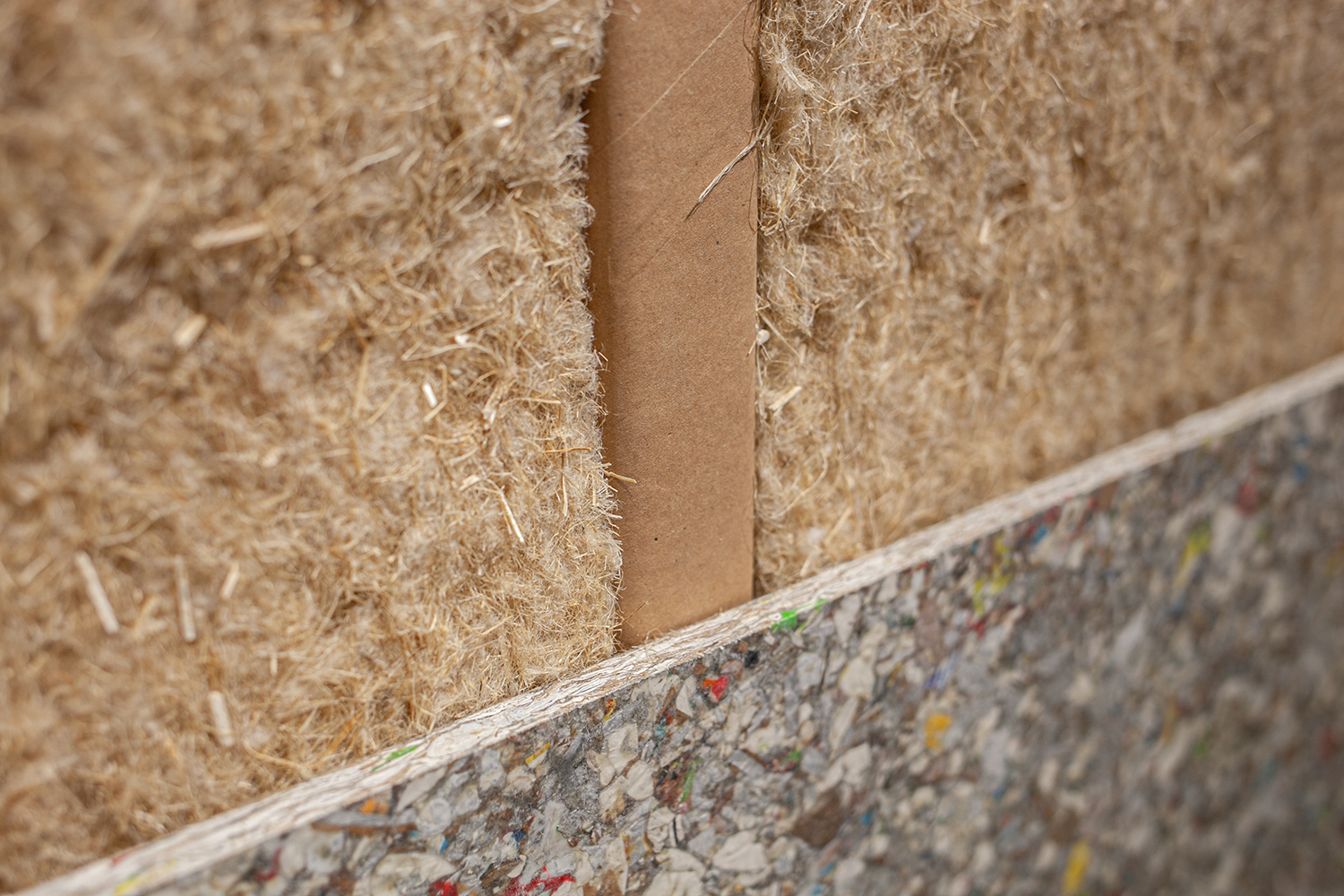
Durability is often decisive. A material may have low embodied carbon, but if it fails early, it drives repeated interventions over its service life, increasing its overall impact over time. By contrast, durable materials reduce waste and maintenance-related emissions by extending service life and delaying the need for new extraction and construction. Designing for disassembly enables reuse, upgrading, or replacement at the component level, without full demolition.
Prefabrication and modular construction support this logic. While they do not automatically guarantee circularity on their own, they make it more achievable by enabling controlled assembly, standardized components, and easier reconfiguration. This helps optimize material use and extend the lifespan of building systems.
Origin, manufacturing, and transport directly affect a material’s real footprint, making traceability a baseline requirement. Local sourcing is often a strong starting point for improving carbon outcomes, as it can reduce transport emissions and improve access to verifiable data. However, “local” alone is not a carbon guarantee and must be evaluated alongside manufacturing energy, efficiency, and scale, in relation to the system as a whole.
Carbon performance depends on verifiable data rather than broad or ambiguous statements. Claims such as “local,” “recycled,” or “natural” only carry weight when supported by documented quantities, processes, and supply-chain data.
To strengthen traceability, the European Commission is advancing digital product passports to improve transparency around a product’s origin, materials, environmental impact, and end-of-life.
End-of-life considerations now influence carbon performance as much as initial specification.
At the end of their service life, materials can often be disassembled and reused, recycled, or, in some bio-based cases, composted under appropriate conditions. Circular design aims to keep materials in use and at value, rather than directing them to landfill. In this context, design for disassembly reinforces circular design by conceiving each element with its next use in mind, keeping materials in circulation and avoiding the energy costs associated with producing entirely new materials.
.png)
This checklist is simplified for clarity. In real projects, each step intersects with dozens of materials, systems, stakeholders, and late-stage changes. Without a shared structure, even well-defined criteria are hard to apply rigorously. As a result, many firms are moving toward shared environments that function as a single source of truth—where material data can be stored, compared, and reused across teams and projects.
Some teams already use revalu’s workspaces to document decisions, record technical data, and organize verified materials. Rather than relying on scattered PDFs or personal folders, they are building a shared resource that evolves with the practice.
Specifying low-impact materials requires technical judgment, but also a structure that supports collective decision-making. If your team is working toward that goal, see how others are using revalu Spaces as a shared material intelligence system.

.png)
.png)
.png)
.png)
.png)
.png)















.png)
.png)
.png)
.png)
.png)
.png)
.png)
.png)
.png)
.png)
.png)
.png)
.png)
.png)
.png)
.png)
.png)
.png)
.png)
.png)
.png)
.png)
.png)
.png)
.png)
.png)
.png)
.png)
.png)
.png)
.png)
.png)
.png)
.png)
.png)
.png)
.png)
.png)
.png)
.png)
.png)

.png)
.png)
.png)
.png)
.png)
.png)
.png)
.png)











.png)